

A content strategy built around customer journeys
Plan messages, evidence and formats around customer questions, with useful roles for AIDA, video and ongoing measurement.
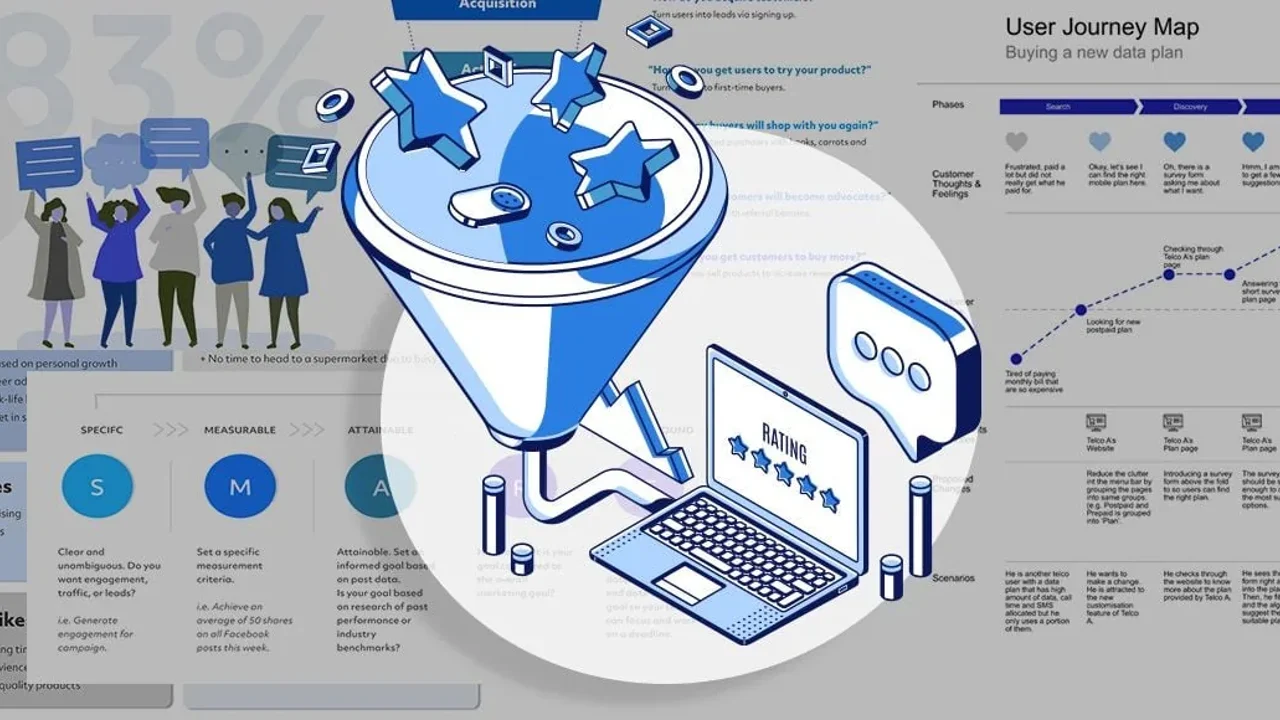
A content strategy connects what the business needs to communicate with what its customers need to understand. It gives each piece a job, an owner and a way to judge whether it is useful.
Define the audience and the situation
Identify the people making the decision and the context in which they encounter the content. Use customer questions, research and operational experience to test assumptions about their needs.
Describe the problem in language the audience recognises. A detailed persona is not useful if it is fictional or does not change the decisions the team makes.
Map questions across the relationship
Consider discovery, evaluation, conversion, onboarding, retention and referral where those stages are relevant. The journey may not be linear, and not every customer will need the same material.
For each question, identify the answer, evidence, format, destination and responsible owner. This helps reveal duplication and gaps before the team commissions another article or campaign.
Use AIDA as a writing aid
Attention, Interest, Desire and Action can help structure a message: establish relevance, explain the offer, support its value and provide an appropriate next step. It is a useful prompt, not a complete model of every purchasing decision.
Use it differently according to the task. A product explanation may need substantial proof and qualifications. A service confirmation may simply need to communicate the next operational step. Avoid manufacturing urgency or turning every helpful answer into a sales pitch.
Give video a defined role
Choose video when a demonstration, explanation or human contribution benefits from motion and sound. Decide what the viewer should learn and where they can go next before investing in production.
A short introduction can lead to a more detailed explanation; an onboarding demonstration can help someone use a product. Provide captions and a text alternative for essential information. Keep the destination and any action consistent with the video's promise.
Views alone do not establish commercial value. Evaluate whether the format helps the intended audience understand or complete the task, alongside appropriate engagement and business measures.
Turn the plan into a content grid
Record the audience, question, purpose, message, evidence, channel, destination and owner. Include how the information will be maintained. A grid makes the plan operational and gives design, media and technology teams shared context.
Growth frameworks that separate acquisition, activation, retention, referral and revenue can help reveal missing work. Use the stages that fit the business rather than forcing every activity into an acronym.
Measure and revise deliberately
Use a measure suited to the content's job. An educational article may help a prospect understand a complex service; an onboarding email should help with a defined task. Neither should be judged solely by whether it produced an immediate purchase.
Combine analytics with customer and sales feedback. Correct misleading information, improve weak answers and consolidate repetition. Our content-hub guide explains how to turn that work into a coherent owned publication.
The strongest strategy is one the team can execute and maintain, with content that remains useful beyond the next campaign deadline.


What would you like to achieve?
Tell us what you want to change. We’ll help you find the right starting point.